Photo caption: Gaetano and his daughter Angela sharing cherished memories as they look through old photos.
By: Kathy Yang, Senior Communications Consultant, Mackenzie Health
When Angela noticed her father Gaetano’s condition declining, she knew life was about to change. A proud Italian immigrant who built a life in Canada after arriving in 1959, Gaetano had always been independent. But by 2022, dementia-related memory loss made living alone nearly impossible. Angela became his primary caregiver, supporting him around the clock.
In spring 2024, Gaetano experienced a sudden bout of delirium, a state of confusion that left him unable to recognize his daughter. “His doctor warned us his dementia would progress quickly, but I didn’t realize how fast it would be,” she recalls.
Delirium is common among hospitalized older adults and can lead to longer stays, increased falls and cognitive decline. “It’s one of the most serious risks for older adults in hospital,” says Peggy Richards, Clinical Nurse Specialist, Seniors Care, at Mackenzie Health. “Without early intervention, it can significantly worsen outcomes.”
Following his family doctor’s advice, Angela brought Gaetano to Cortellucci Vaughan Hospital, one of Mackenzie Health’s two hospital sites, where he was admitted to the Behavioural Acute Care for the Elderly (BACE) Unit, a specialized environment for patients with acute medical needs and cognitive challenges such as dementia or delirium.
Bright lighting, floral murals and spacious rooms create a warm, welcoming environment, while a dedicated team, including a geriatric psychiatrist, nurse practitioner and behavioural specialist, provides integrated medical and behavioural care. For Gaetano, this meant personalized therapies, frequent observation and visits from therapy dogs to keep him engaged.
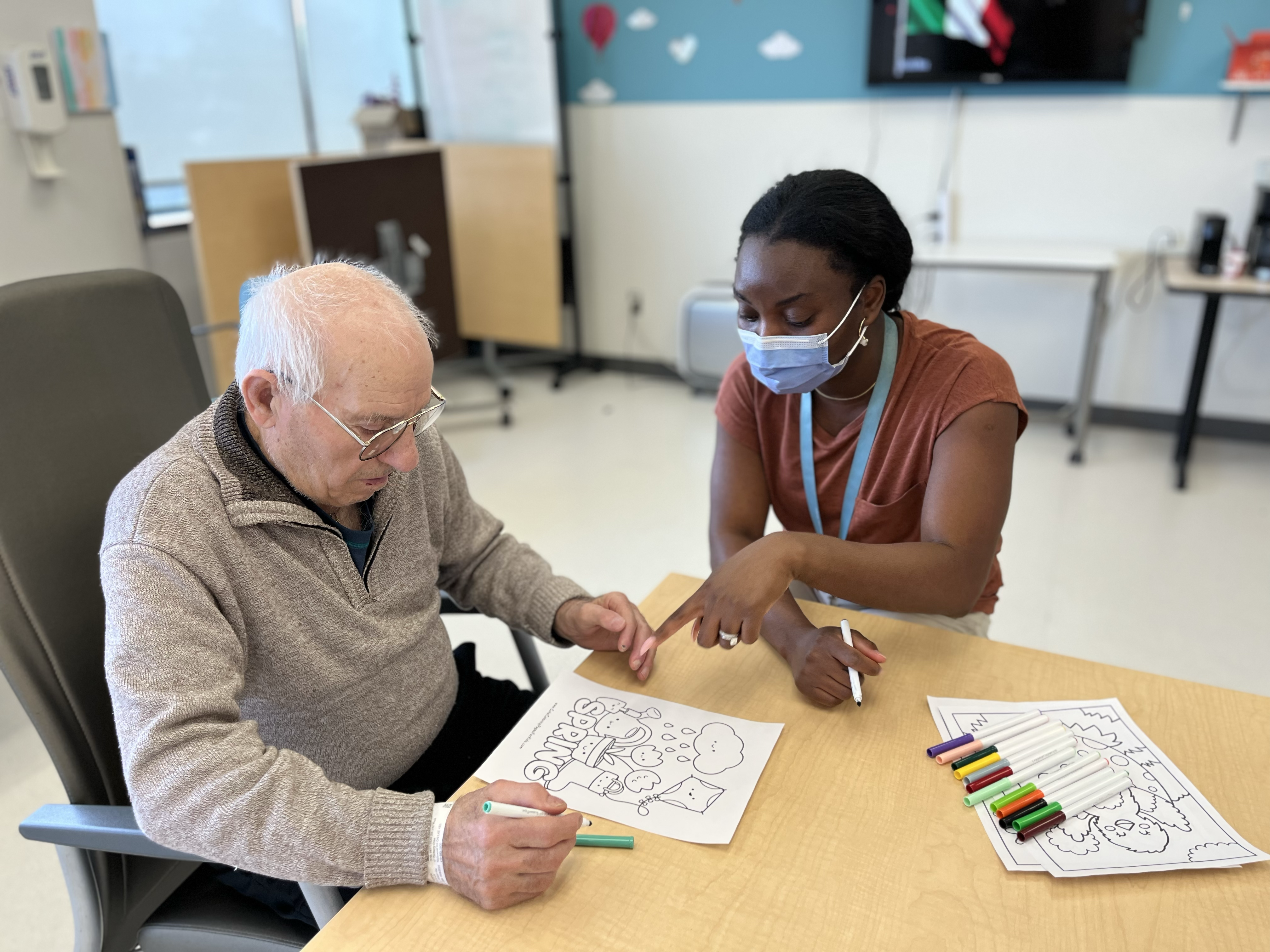
Photo caption: Gaetano and Ofei, Recreation Therapist at Mackenzie Health’s Reactivation Care Centre, engaging in artwork.
With this support, Gaetano’s delirium symptoms improved, and he transitioned to Mackenzie Health’s Reactivation Care Centre (RCC) for rehabilitation and discharge planning. There, he thrived through music, gardening and social activities.
“Watering the garden meant so much to him,” Angela says. “He felt needed, and it brought him back to his roots of growing his own food.”
Angela and Gaetano’s experience is just one of thousands and reflects a broader reality: older adults make up 70 per cent of Mackenzie Health’s inpatients, and their care needs are complex. To meet this challenge, Mackenzie Health launched its first Seniors Care Strategy in 2024, a co-ordinated, evidence-based plan to deliver safer, more personalized care for older adults. The strategy is grounded in safety, resilience and continuous learning, all principles of Mackenzie Health’s commitment to patient care excellence and high reliability.
Building Expertise and Confidence
The transformation began with education. Through a partnership with Nurses Improving Care for Healthsystem Elders (NICHE), an education and consultation program, Mackenzie Health introduced specialized training for nurses, including a six-hour foundational course and a “Senior Care Champion” program. To date, more than one-third of its nurses have completed training, and more than a hundred more have become Champions, embedding senior-friendly practices across the organization.
Preventing Delirium Before it Starts
Delirium prevention was one of the strategy’s first priorities. Mackenzie Health developed the ADAPT Model (Acknowledge, Delirium, Assess every shift, Prevent where possible, Treat if it develops) and integrated a delirium checklist into its electronic medical record system. This ensures timely screening and intervention for every patient.
Designing Care around Older Adults’ Needs
Beyond education and protocols, Mackenzie Health has invested in specialized spaces like the BACE Unit, creating environments that combine safety, comfort and holistic care.
Planning for the Future
York Region is aging fast. By 2051, one in four residents will be 65 or older. Mackenzie Health is planning for that future now.
Its refreshed Seniors Care Strategy (2025–2028) focuses on practical steps that make a real difference: a new mobility program to reduce falls, a seniors care toolkit co-designed with patients and families and stronger community partnerships so care continues seamlessly beyond the hospital environment.
To enable this work, Mackenzie Health is embedding senior-friendly principles into everything it does. From integrating older adult care into onboarding and annual training to ensuring every staff member receives foundational education on senior-friendly practices, the organization is working to ensure that every person, in every role, helps create a culture where older adults feel safe, respected and cared for.
For Angela and many caregivers like her, these efforts make all the difference. “Knowing my dad is truly cared for — not just seen as a number in the unit — brings me peace of mind,” she says.