Photo caption: Members of St. Joseph's Care Group’s Quality and N’doo’owe Binesi teams at the Centre for Applied Health Research 2026 Showcase of Health Research. (Left to right) Hemalatha Vijayakumar, Andrew Koscielniak, Jason Whatley, and Sumeet Kumar.
By: Sumeet Kumar, Director, Corporate Quality, and Andrew Koscielniak, Director, Indigenous Health, N’doo’owe Binesi, St. Joseph’s Care Group, Thunder Bay, Ontario
Across health care, organizations are recognizing that improving quality and safety requires more than performance indicators or operational measures and processes. It also requires culturally safe environments, meaningful relationships, and care that respects diverse ways of knowing and experiencing wellness. At St. Joseph’s Care Group (SJCG), this understanding has become an important part of our ongoing commitment to Truth and Reconciliation, Indigenous cultural safety, and addressing systemic racism and discrimination within health care.
Launched in 2018, Wiidosem Dabasendizowin – Walking with Humility is a living document and long-term strategy that continues to guide our work to improve healthcare together with Indigenous Peoples. Building on these ongoing efforts, SJCG’s Board of Directors recently created a formal statement of commitment to working alongside the Anishinaabek to advance culturally safe services and address systemic barriers, biases, and inequities across organizational systems.
As SJCG reflected on how reconciliation commitments could influence everyday experiences of care, it became clear that quality and safety systems also needed to evolve. Rather than viewing cultural safety as separate from quality improvement, SJCG began exploring how Indigenous worldviews could help shape the organization’s broader understanding of quality and safety.
Guided by Shared Commitments
Traditional quality and safety approaches in health care have often focused on clinical outcomes, operational performance, and standardized processes. While important, these approaches do not always fully capture how people experience care, particularly Indigenous Peoples, who may experience racism, exclusion, mistrust, or culturally unsafe environments within health care systems.
Grounded in the teachings of Mi’kmaw Elder Albert Marshall, Etuaptmumk – Two-Eyed Seeing encourages us to “see from one eye with the strengths of Indigenous knowledges and ways of knowing, and from the other eye with the strengths of Western knowledges and ways of knowing, and using both these eyes together” (Bartlett, Marshall, & Marshall, 2012).
This guiding principle creates opportunities for greater respect and understanding between Indigenous and Western approaches to care. By integrating Two-Eyed Seeing into our Quality program, SJCG is working toward more meaningfully embedding Indigenous worldviews into everyday practice, leadership, and organizational improvement processes.
Importantly, the Framework was co-designed by listening to the voices and experiences of our community. By engaging Indigenous partners, staff, clients and families, Elders, and community stakeholders, SJCG strengthened relationships while building a Framework grounded in diverse perspectives and lived experiences.
A Wholistic Model of Care
When SJCG developed our Quality and Safety Framework, these commitments became foundational to our approach. In collaboration, the Quality, N'doo'owe Binesi (Indigenous Health), and Equity, Diversity and Inclusion teams at SJCG integrated Two-Eyed Seeing into the Framework to support how quality and cultural safety are understood across the organization.
The resulting Framework reflects this integrated approach visually and conceptually, bringing together Indigenous teachings, people-centred care, and core principles of health care quality into a single model.
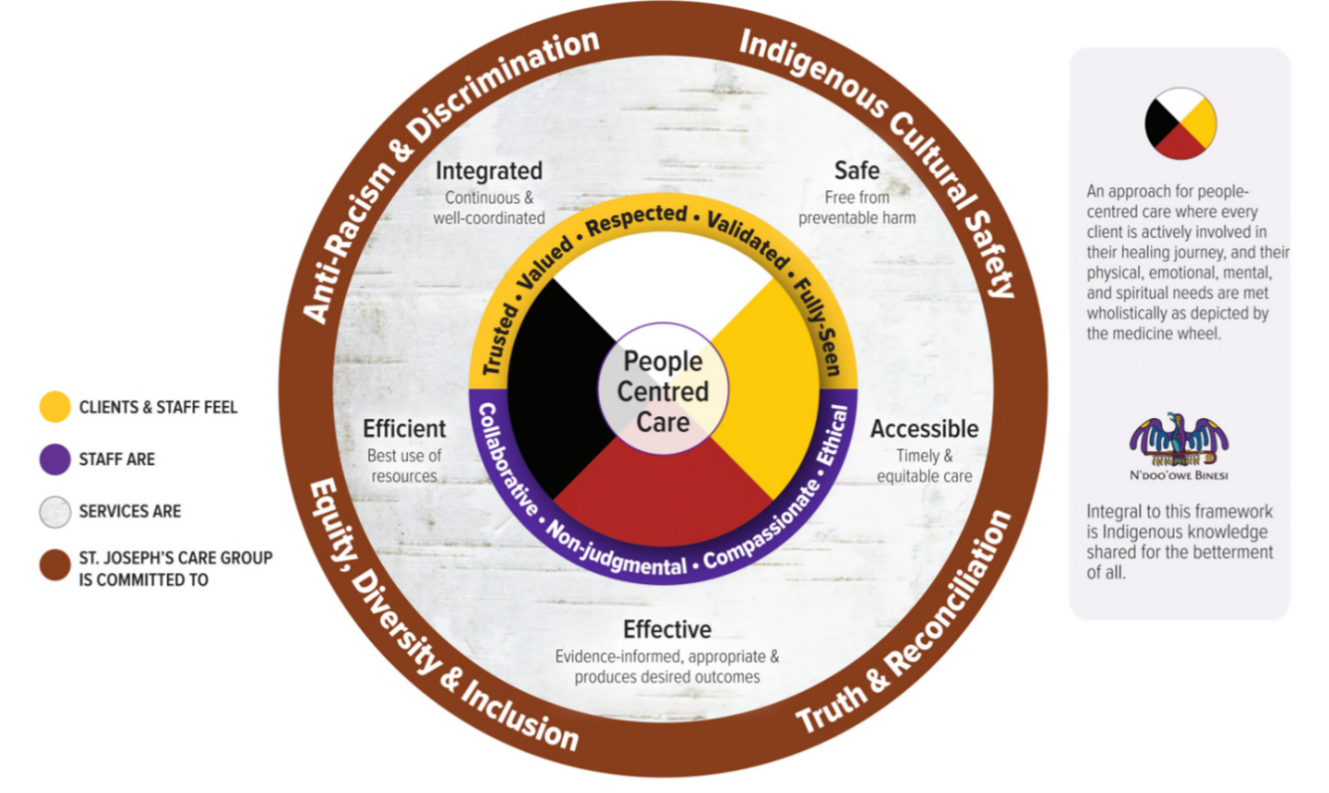 Photo caption: St. Joseph’s Care Group’s Quality and Safety Framework
At the center of the Framework is People-Centred Care, recognizing that high-quality care must support physical, mental, emotional, and spiritual wellbeing. The design visually reflects this wholistic approach through the surrounding Medicine Wheel. It also incorporates established dimensions of health care quality – including safety, accessibility, efficiency, effectiveness, and integrated care – within a circle of birch bark that symbolizes resilience, relationships, respect, and connection.
The Framework was not designed as a standalone quality initiative. Rather, it reflects SJCG’s understanding that quality and safety are shaped not only by systems and processes, but also by how people experience care, how teams work together, and how organizations foster trust, inclusion, belonging, and a sense of safety within the health care system.
Lessons Learned
Several important lessons emerged throughout the development of SJCG’s Quality and Safety Framework.
First, embedding Indigenous knowledge into organizational systems begins with relationships and trust. Indigenous Peoples must be meaningfully involved from the beginning, with their voices guiding the work.
Second, SJCG’s experience reinforced that cultural safety and quality improvement are deeply interconnected. Trust, respect, inclusion, and psychological safety are essential to high-quality care and positive health experiences.
Third, SJCG recognizes that applying the Framework in clinical settings requires translating Two-Eyed Seeing into practical actions that reinforce cultural safety in everyday care.
Finally, embedding Two-Eyed Seeing into organizational practice is ongoing work. It requires humility, reflection, continuous learning, and sustained partnership with Indigenous Peoples. SJCG continues to learn, reflect, and refine how the Framework is applied across teams and services.
Today, the Quality and Safety Framework guides quality improvement, leadership discussions, staff engagement, and education efforts across the organization. SJCG’s experience demonstrates how organizations can move beyond treating reconciliation, cultural safety, and quality improvement as separate priorities. By integrating Indigenous knowledge and worldviews directly into quality and safety systems, we can strengthen relationships, build trust, and support culturally inclusive and equitable care environments for the communities we serve.