For Hank Vaane, innovative group therapy to regain the ability to swallow means he can once again look forward to sharing a meal with his son – and enjoying a favourite chocolate bar.
So many of life's pleasures revolve around food – celebrations, traditions, rituals, holidays and gatherings. For those who have difficulty swallowing, however, these joys can become hardships, often isolating those struggling with this debilitating condition.
It's called dysphagia and Penny Welch-West, a speech-language pathologist (SLP) at St. Joseph's Parkwood Institute, knows well the impact it can have on her patients' quality of life.
“If friends want to meet for coffee, or family members gather for a holiday meal, dysphagia patients may feel left out," says Penny. “It doesn't help that these individuals are often on feeding tubes, hidden under clothing, masking their challenges, which makes this an often invisible and misunderstood struggle."
A person swallows 600 to 1000 times a day “and most of us don't think about it," adds Penny. “For people with dysphagia, it's all they think about."
To support her patients, Penny came up with an idea that brings individuals together to work on swallowing exercises and rehabilitation. Regardless of the injury or condition that left them unable to swallow, these patients learn they are not alone, draw on support from one another, and embark on the recovery journey collectively in a supportive social setting. Called the Dysphagia Intervention Group (DIGs), the innovative approach quickly began making a tremendous difference for patients like Judy Purves.
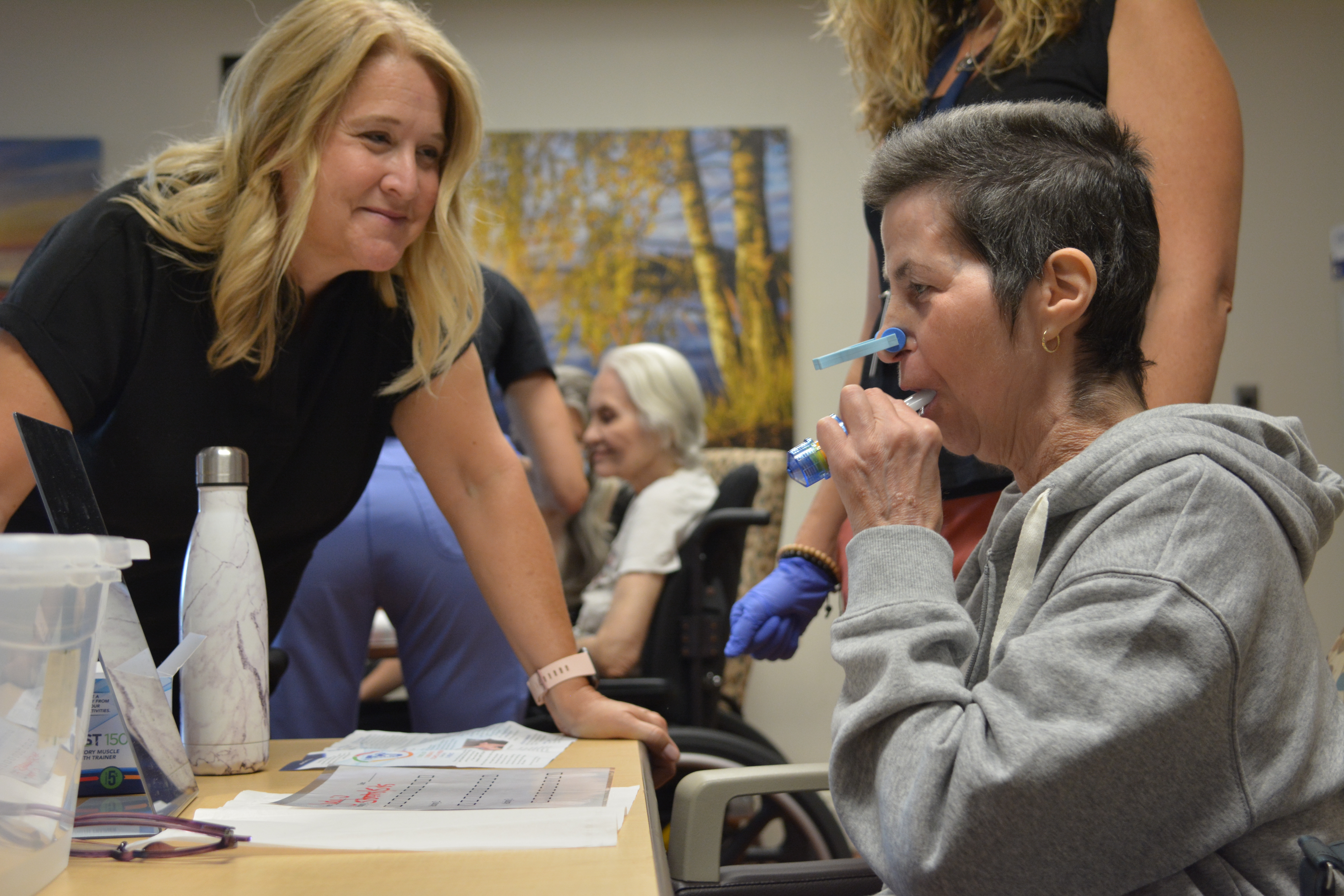 In March 2023, Judy was hospitalized with a rare bacterial infection in her bloodstream that nearly killed her. She was on life support in intensive care for two months and spent another two months in hospital. Her muscles atrophied and she lost the ability to walk and, perhaps more importantly, swallow. Judy was transferred to St. Joseph's Parkwood Institute, where she spent 10 weeks receiving specialized care from the Complex Care Program and was introduced to the DIGs program.
“I was frustrated and apprehensive about my inability to swallow properly but Penny assured me that her program could help," recalls Judy. “I was inspired by her encouragement and enthusiasm."
Pictured above: A serious illness left Judy Purves unable to swallow but a unique group therapy program at St. Joseph's Health Care London's Parkwood Institute led her back to eating her favourite foods. Learning to swallow, she says, “was just as important as learning to walk again."
The DIGs sessions incorporate specialized rehabilitation equipment, breathing and targeted expiratory exercises, and an opportunity for participants to practice swallowing at their own pace with their own food goals in mind. For example, some are working toward swallowing a cookie or piece of chocolate, while others are working on a pudding cup. Penny and her colleagues work with each patient to teach them proper swallowing form and function and support them with their individual goals. Music adds to the ambiance in various ways. Not only does it lift moods and create an enjoyable backdrop that boosts camaraderie, but therapeutic drills can match the beat or simply provide a distraction for sets that require repetition.
“Learning (these techniques) in a group environment was helpful in that we all shared a common issue," Judy says. “The videos and music helped bond the group."
The DIGs sessions integrate the latest interventions and protocols in treating dysphagia, which are showing promise in speeding up recovery. For example, the DIGs is set to become the only group of its kind in Canada leveraging innovative biofeedback equipment. In the coming months, this equipment will allow patients to benefit from sensors that can be attached to their throat to provide real-time information on muscle effort exerted and, most importantly, the amplitude of swallowing efforts, explains Penny. It will help patients and SLPs alike gauge recovery progress and the need to increase therapy intensity.
“DIGs is a place where patients come to learn about their swallowing function from the inside out," says Penny. “We are using the best in evidence-based treatment, a circuit of exercise training, and the patient has an opportunity to engage with equipment and receive targeted coaching from a speech-language pathologist. All of this happens in a social group setting where patients receive and provide support to one another."
While rehabilitation progress for various conditions is often highly visible, like improvements seen when regaining mobility, “the invisible challenges and gains made in dysphagia therapy may not always be apparent – yet they matter just as much," adds Penny.
Judy would know. Today she is home and back to eating her favourite food – pizza. Learning to swallow, she says, “was just as important as learning to walk again."