Photo caption: (left to right) At University Health Network's Toronto Western Hospital, Marsha Alvares, Project Director, Orthopaedics, led the development and implementation of Code Hip with Silvi Groe, Clinical Director and Dr. Christian Veillette, Orthopaedic Surgeon and Division Head.
Each year, more than 13,000 Ontarians experience a hip fracture. For older adults, these injuries can result in reduced mobility, lost independence and even death. Annual hip fracture health system expenditures exceed $282 million; however, research shows that hip fracture surgery within 48 hours is associated with better patient outcomes, shorter hospital stays and lower overall costs.
At Toronto Western Hospital, part of University Health Network (UHN), an interprofessional team developed Code Hip, a standardized pathway that accelerates assessment, diagnosis, admission, and surgery for patients with hip fractures. Based on Ontario Health’s Hip Fracture: Care for People with Fragility Fractures quality standard, the initiative demonstrates that measurable improvement is achievable through data-driven accountability and interprofessional collaboration.
Data-Driven Change
In spring 2024, GTA Rehab Network data showed that UHN was performing below peer hospitals, with only 68–74% of patients with hip fractures receiving surgery within 48 hours of emergency department (ED) admission. In response, UHN set an ambitious goal: to consistently provide surgery within 48 hours for 90% of these patients.
Interprofessional collaboration
Marsha Alvares, Project Director – Orthopaedics, led the development and implementation of Code Hip with Dr. Christian Veillette, Orthopaedic Surgeon and Division Head, and Silvi Groe, Clinical Director, Schroeder Arthritis Institute. Recognizing that success required co-design and engagement of physician and operational leadership across the pathway, UHN formed a working group spanning Orthopaedic Surgery, Emergency Medicine, Anaesthesia, General Internal Medicine, Medical Imaging, Patient Flow, Surgical Services, Collaborative Academic Practice, and UHN Connect Paging.
Evidence-Based Improvement
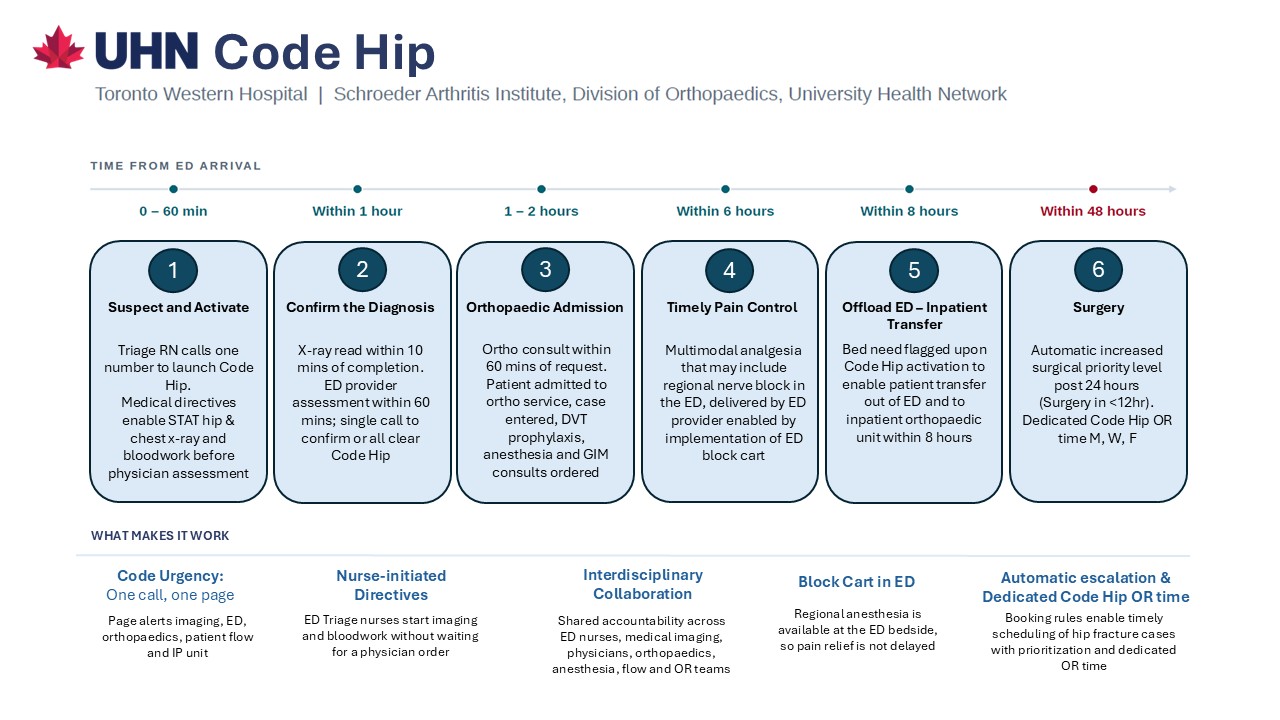
The group compared existing practices with the 2024 Hip Fracture quality standard and created the Code Hip algorithm around six time-based measures: imaging and emergency physician assessment within one hour of ED admission; orthopaedic consultation within one hour of Code Hip confirmation; multimodal analgesia within six hours; inpatient transfer within eight hours; and surgery within 48 hours of ED admission.
Designing a Faster Pathway to Surgery
Code Hip redesigned the existing hip fracture pathway by leveraging clinicians’ full scope to expedite time to surgery. Updated medical directives enabled ED triage nurses to activate the code and order diagnostic imaging and bloodwork. Moving diagnosis from orthopaedics to the earlier ED provider assessment further expedited care. Automatic escalation of surgical priority after 24 hours coupled with dedicated Code Hip operating room time improved timeliness to surgery.
During implementation, project leads worked alongside frontline teams to provide hands-on support, gather feedback and make iterative improvements. Code Hip education was delivered to existing staff and embedded into staff orientation and simulation activities. Department-level communications, visual reminders, in-services, daily audits and weekly reporting reinforced expectations and ensured staff remained informed, supported and recognized for their role in improving care.
Demonstrating Measurable Results
Between June 2025 and August 2026, 215 patients received care through the Code Hip pathway. Ninety-two per cent underwent surgery within 48 hours, up from the pre-implementation baseline of 68–74%. Median time from emergency department arrival to surgery was 28.7 hours.
Results improved across the pathway:
- 88% of patients received imaging within one hour
- 93% received an emergency physician assessment within one hour
- 92% received an orthopaedic consultation within one hour of Code Hip confirmation
- 81% were transferred to an inpatient unit within eight hours
- 99% received timely multimodal pain management.
Building Sustainability for Long-Term Success
To support sustainability, UHN is embedding Code Hip pathway tracking and reporting in its electronic medical record, reducing reliance on manual processes and enabling ongoing performance monitoring on key metrics. Standardized medical directives, order sets, documentation and operating room booking workflows integrate Code Hip into routine care. Together, these supports ensure that Code Hip practices become standardized operating procedure at UHN.
Code Hip’s success reflects the commitment of UHN’s clinical and operational leaders and countless frontline staff whose expertise, collaboration and dedication to improving hip fracture care have been instrumental in developing, implementing and sustaining the pathway.
A Blueprint for Scale Across Ontario
With Ontario Health’s announcement of a three-year strategy to improve hip fracture care, UHN’s Code Hip initiative offers hospitals a blueprint for delivering timely, high-quality hip fracture care. Since the UHN team presented Code Hip at the 2026 Canadian Orthopaedic Association Annual Meeting and at the June 11th Project ECHO Orthogeriatrics session (Code Hip begins at 21:00), many hospitals have reached out to UHN to learn more.