Photo caption: Dr. Roberta Minna, Chief of Surgery and Co-Medical Director, Surgical Services, William Osler Health System.
Dr. Roberta Minna knows a thing or two about surgical backlogs. It was just a few short years ago that her hospital system, William Osler Health System (Osler) was treating some of the highest patient volumes for COVID-19 in the province, leading to extensive surgery wait times and significant staffing pressures.
Flip to today, and the multi-site community teaching hospital is delivering some of the lowest surgical wait times in Ontario’s central region with more than 96 per cent of all surgical cases completed within provincial targets. What sparked the rapid turn-around?
Dr. Minna, Chief of Surgery and Co-Medical Director, Surgical Services, William Osler Health System, notes that several success factors have contributed to Osler’s wait time improvement, including investing deeply in a highly successful recruitment and retention strategy, an organization-wide focus on people-centred care, a commitment to finding more efficient ways of doing things, and a surgical team with an aptitude for innovation. It’s the latter that excites her the most.
“Our surgeons and the team want what’s best for their patients, so there’s always a willingness to adapt and learn something new and nowhere is that more evident than in our growing surgical robotics program,” said Dr. Minna. “Greater access to robot-assisted surgeries reduces the risk for complications, improves patient recovery time, leads to shortened lengths of stay and contributes to an overall better patient experience.”
Osler’s growing interest in surgical robotics started in 2023 in orthopaedic surgeries, with adoption of the ROSA® Knee System for total knee replacement surgery. It combines computer guidance with robotic precision for precise placement of knee implants based on a patient’s unique knee anatomy. For patients, it leads to less pain, faster recovery times and shorter hospital stays.
Soon after, Osler’s teams began using the Intellijoint HIP™, a surgeon-controlled, computer-assisted navigation system that improves accurate alignment of the hip implant, reducing leg length discrepancies, hip dislocations and the need for revision surgeries post-operatively, significantly improving the patient experience.
Since that time, Osler’s adoption of robotics has expanded into cancer surgeries, where it uses the revolutionary MOLLI® 2 System to perform breast cancer surgeries and, more recently, the world-renowned Da Vinci Xi Robotic Surgical System for prostate and kidney cancer surgeries.
Due to efficiencies generated by use of the MOLLI® 2 System, Osler is able to complete more breast cancer surgeries in a day than previously possible, and plans to expand use of the Da Vinci in the coming months to include cancer surgeries for the urinary, chest and reproductive systems.
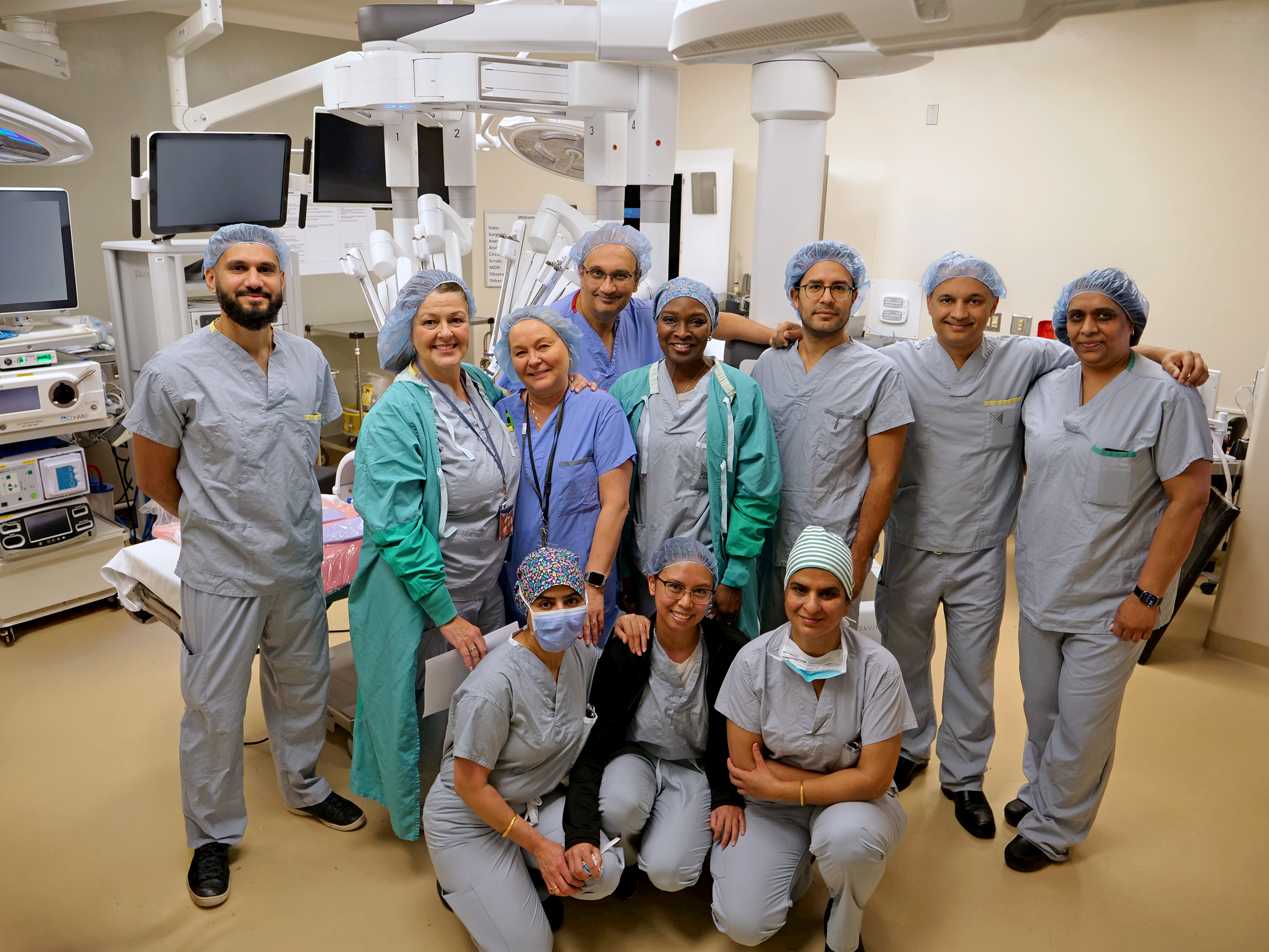
“Even though the Da Vinci Xi Robotic Surgical System is relatively new at Osler, we’re already seeing its impact on shorter lengths of stay,” said Alean Jackman, Clinical Director, Surgical and Ambulatory Services, who agrees with Dr. Minna that Osler’s growing robotics program is contributing to the hospital’s improved surgical wait times.
“We really poured a lot of energy into building and sustaining a strong team getting to get to where we are today. With a people-centred team that’s energized to adopt new ways of delivering care, we’re able to see more patients more quickly, while continuing to provide innovative health care delivered with compassion,” said Fred Go, Vice President, Clinical Services, William Osler Health System.
Photo caption: William Osler Health System's Da Vinci Surgical Team.